


I didn’t mean to start a newsletter.
I mean, I did, technically. You don’t accidentally sign up for Substack and accidentally write things and accidentally click publish. There’s intention in there somewhere. But the newsletter I ended up with wasn’t the newsletter I thought I was making.
It was supposed to be demos. Short videos showing that the AI stuff actually worked. “Here, look, it’s not vaporware, watch me do it live.” Burn a few takes flubbing the speaking parts. Ship it with some code you could run yourself.
Late 2024, early 2025, I was building a lot of these little AI tools. Hacked-together things. A TDD pair programming agent here, a prompt-driven whatever there. And every time I’d wire something together and it would actually work, I’d feel this specific kind of amazement (I still do every couple days or so). The kind where you can’t believe your idea actually worked, but it did, and now you want to show someone.
So I started showing people.
And then I showed some more.
And then somewhere around the middle of the year, showing became thinking, and thinking became writing, and writing became whatever this is now.
The Numbers Part
Zero. That’s what I started with. Zero subscribers, zero posts, zero idea what I was doing. Just a vague sense that I should probably be writing and sharing this stuff because I was spending a lot of time doing it anyway.
Now?
31 published posts.
1,828 subscribers.
256,000 views.
Several trips to the front page of Hacker News.
A few conference talks. A bunch of podcast appearances.
Each post felt like throwing spaghetti at a wall. You write something, you ship it, and then you wait to see if the universe decides to care.
Sometimes it cares a lot.
The Times Hacker News Noticed
The first hit was Introducing MonkeysPaw, a prompt-driven web framework in Ruby where all the pages are prompts and what you see is whatever the LLM thinks you meant. It started out as a surprise to reveal at the end of my We Were Voyagers. We Can Voyage Again! talk for Artificial Ruby that made it’s way all the way to closing out the first day of Rocky Mountain Ruby. Who knew it would resonate with so many people?
A week later, Wasting Inferences with Aider hit, which looks quaint rewatching it now that we’ve all spent the holidays with Claude Code and Opus 4.5. It was also a little over a month before Claude Code went GA, what a different time...
The next week: The Coming Knowledge-Work Supply Chain Crisis.
Three weeks in a row, front page of HN.
I started to wonder if I’d accidentally figured something out. I had not. The next several posts didn’t crack the front page. The spaghetti landed differently.
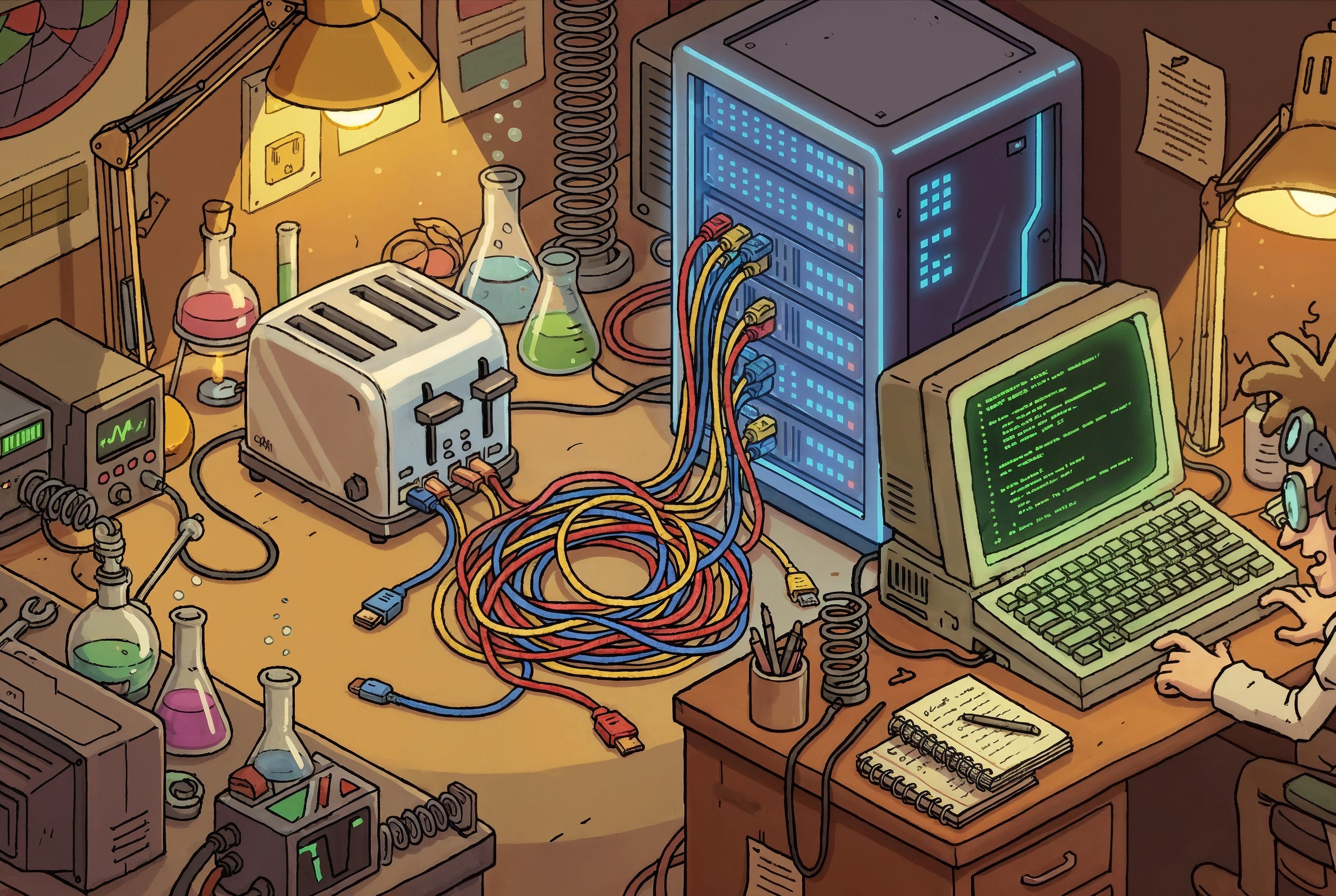
Then in June, MCP: An (Accidentally) Universal Plugin System went kind of viral. Currently sitting at 98,000 views. The one about how the protocol for giving AI tools is also accidentally a protocol for giving everything tools. The toaster with HDMI output. I haven’t seen many people using MCP for non-AI things yet, but keep an eye out on this newsletter next year for some more explorations.
And then Nobody Knows How To Build With AI Yet crossed 50,000 views. The one where I admitted that my four-document system for working with Claude wasn’t wisdom, it was just whatever happened to work that particular week.
Here’s my theory about why those posts did well: they said things people were already thinking but hadn’t quite said out loud yet. They named the thing.
How The Newsletter Grew Up
When I started, every post had a video. Me, talking to a camera, demonstrating something live. Here’s the code. here’s it running. Here’s what happens when the AI does the thing. Proof. Evidence. “It works on my machine” rendered literally.
By mid-year, something shifted.
The tools got better. Claude Code shipped (GA’d on May 22!). Agents became a thing everyone could actually use, not just a thing you could see me stitch together. The skepticism started evaporating.
And so the posts changed too. Less “watch me prove this works” and more “here’s what I think this means". Essays about the philosophical mess of programming with AI. Theories about pendulums and formalists and hermit crabs in tide pools. Stories about building Protocollie in four days while making breakfast and watching TV.
The demos didn’t go away, but they started sharing space with something else. Thinking. Wondering. Occasionally shouting into the void about technical debt entering its ZIRP era.
Three Posts That Mattered to Me
Safe is What We Call Things Later is probably my favorite thing I wrote this year. The one with the girl yelling at the ocean because the tide kept moving her hermit crabs. About how the informalists and formalists keep trading places throughout computing history. About how we’re in the wildest informal moment yet, and the Dijkstra disciples will eventually arrive to make it safe, and then the pendulum will swing again.
I also really enjoyed writing The Only Skill That Matters Now. The Gretzky thing. “Skate to where the puck is going” only works if you can already skate. We need to focus on getting really good at skating at the speed of AI.
The Cause of, and the Solution to, All Your Team’s Problems. The one about how much pain and agony a team experiences if they don’t all start using AI at the same time. It was also part of a fun, old-school, back-and-forth blog discussion with Justin Searls, which kicked off with him responding to The Parallel Lives of an AI Engineer with There Is No ‘AI’ in ‘Team’.
None of these were viral hits. But they’re the ones where I felt like I had the most fun writing and re-reading.
The Shape of Next Year
With Opus 4.5 on Claude Code, I think it’s time for the newsletter to evolve again.
We’ll still have demos and open source code. That’s still the foundation. But I’m going to start sharing things that are a lot more baked. Sometimes it’ll be “here’s a script that does a cool thing” but more often it’ll be “here’s a whole product that does a real thing for real people.’
I haven’t put out any posts in the last few weeks, but I’ve been building stuff in the background. The newsletter for 2026 is going to be about shipping those bigger things and about the lessons that come from going beyond “it just works on my machine” to “it works on yours too.”
The essays won’t stop. I’ve got too many thoughts about this moment we’re in, this messy middle" where nobody really knows what they’re doing but everyone’s doing it anyway. When even people like Andrej Karpathy are sharing publicly how far behind they feel, exposing how uneasy it feels to be forced to become a junior developer again for experienced developers.
The Thank You Section
This is the part of the year-end post where you thank people. But I don’t really know how to do that without it sounding like an awards speech.
So I’ll just say this: if you subscribed, thank you. If you read something and it made you think differently about what you’re building, that’s exactly what I’m hoping for. If you commented, or sent me an email, or joined the Discord, or mentioned a post to a friend, just know that you made my day.
I started 2025 with zero subscribers and a vague idea about sharing some of the crazy things I was making and seeing.
I’m ending it with almost two thousand of you and absolutely no idea what 2026 is going to bring.
But I do know one thing: I’m going to keep building weird stuff and sharing it.
Thanks for reading.
I'm also exploring an idea of creating a series of short agentic coding tutorial videos at $15/month with a new 10-15 minute video every 2 weeks. Let me know if any of you out there be interested in something like that.