


Penn & Teller have this philosophy about their craft. Or, I guess, all stage magicians do, but Penn & Teller are the ones who spend the most time talking about it.
They will spend months on a single trick. Years, sometimes. More time on something than anyone else might reasonably expect, they’ve said. The same motion. The same timing. The same angle of the wrist at the exact same millisecond. Eliminate every possible deviation from the plan.
Because when you’re an illusionist… you only get one shot.
One audience. One moment. One chance for the coin to appear behind the ear instead of falling into your sleeve and rolling under the table while everyone watches on in secondhand embarrassment.
The illusionist lives in scarcity because the medium demands it. The show is live. The audience is right there. The trick either works or it doesn’t. So you rehearse. You refine. You do the thing ten thousand times in a mirror until your hands move like they belong to someone who has never once been nervous.
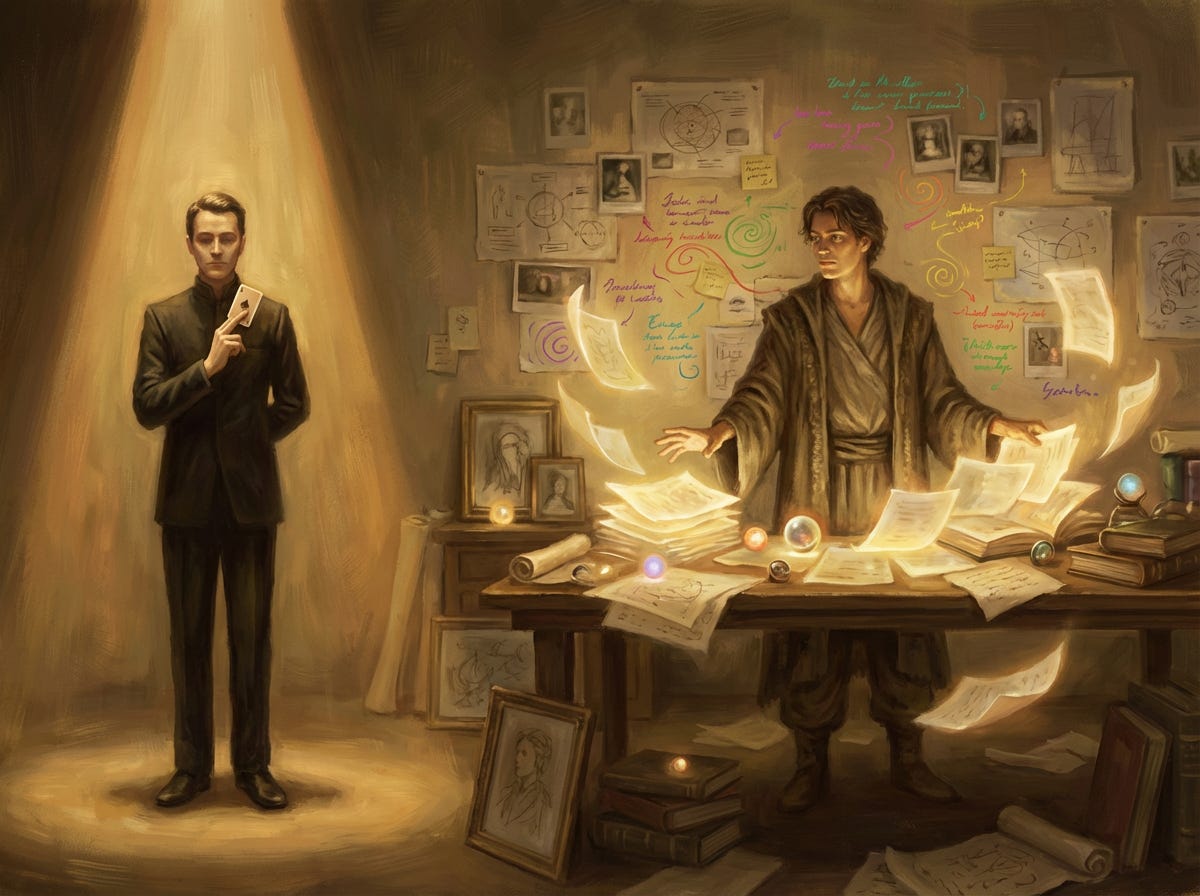
Conjurers, on the other hand, do it differently.
The Conjurer
Have you ever watched a sports photographer work? I mean really watched one?
They’re crouched at the edge of a basketball court or pressed against the boards at a hockey game and they are just...
Thousands of photos in a single night. A shutter that sounds like you’re speeding down a hill on your bike with a playing card in your spokes. And then they go home, or back to the press room, or wherever it is that photographers go when the game ends, and they start throwing photos away.
(I guess technically it might be called curating?)
They took 3,000 shots and now they need 12. So they scroll and squint and delete and compare and zoom in on this one ”no, the elbow’s wrong,” “try that one,” “the light’s perfect but the expression is...,” “wait, this one. This one is the one.”
Then they go into this deeply illusionist mode where they adjust the contrast, tweak the color balance, crop it just so, remove that one distracting thing in the background. The last mile is all precision. All devotion.
But the finding of the thing? That was abundance. That was overflow. That was “let me generate so much raw material that the good stuff can’t help but show up somewhere in the pile.”
The conjurer summons many. Then chooses.
Film
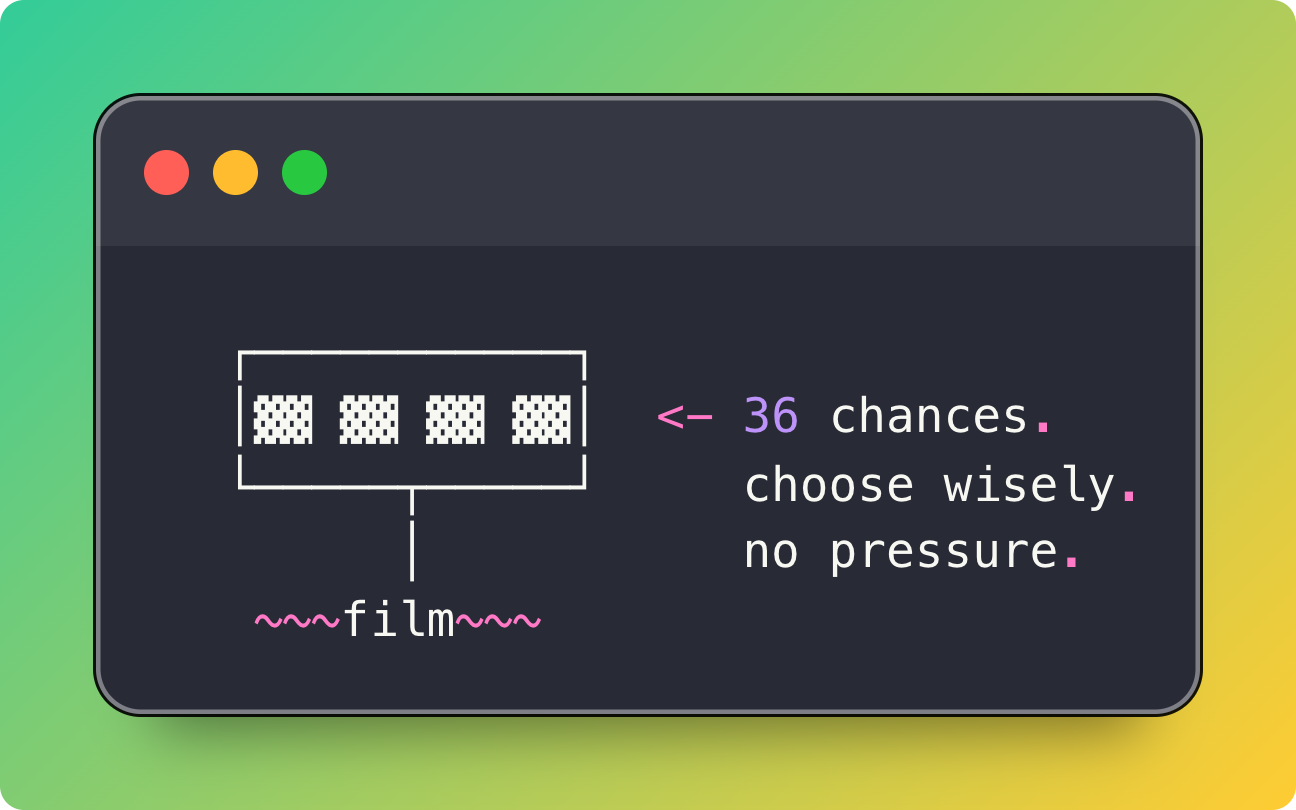
There was a time (some of you out there are young enough that this might sound like a fairy tale, but if you’re old enough to get the NES reference from my last post, you know it’s true) when every photograph cost money. Film cost money. Developing cost money. You had 24 or 36 exposures on a roll and each one was a tiny investment, a little act of faith that this moment was worth one of your limited chances.
People were illusionists with cameras. They had to be.
And then digital happened and suddenly the cost of a photograph was nothing. All those un-photographed lunches you’d eaten your entire life could now be captured.
Photography went from scarcity to abundance within a single generation and some people mourned it. “The craft is dying,” they said, while a teenager with an iPhone was accidentally taking better street photography than most professionals because she took 400 shots walking to school and one of them happened to catch the light doing something cool on a fire escape.
But I’m talking about it now because I want you to look at everything that grew in that new soil. When photos became abundant and disposable, entirely new ways of relating to photography became possible. Ways that couldn’t have existed before because the economics didn’t allow it. Flickr appeared and we built communities around our photos. Google Photos gave us unlimited storage and let us search through it. Instagram turned curation into a daily practice for millions of people who’d never used the word curation. Lightroom gave every hobbyist a digital darkroom. All of these were about living differently in relation to an abundant medium: organizing it, sharing it, filtering it, searching it, remixing it.
Want to explore this more? Here’s an artifact I put together about photography going from scarcity to abundance for you.
An entire ecosystem of tools and behaviors and cultures bloomed simply because the quantity of photography became effectively infinite. Scarcity had been the constraint, and when the constraint lifted, people didn’t just do the old thing faster. They did new things entirely.
And I’ve spent the last few years wondering about what these new things might look like now with AI.
Accidental Discoveries
Well, last year I shared this thing I built called Monkey’s Paw.
(If you were around for Monkey’s Paw, a prompt-driven web framework I built that broke containment a little bit last year. Hi, happy almost anniversary. If not, here’s that post.)
I spent most of last year using Monkey’s Paw for presentations. The slides were good, I think. Definitely more fun than anything I could have made myself. But the experience of using it left something to be desired. Iteration was slow and I’d accidentally lose slides I wanted to keep all the time. The problem was I was still thinking about it with an illusionist mindset. One prompt, one generation, one shot.
But then a couple things happened all at once, the way things do in AI these days, that made that Monkey’s Paw workflow obsolete.
NotebookLM came along. A model called Nano Banana Pro showed up and turned out to be unreasonably good at generating images with legible text in them, which if you’ve been paying attention to image generation you know is a small miracle. And suddenly, slide deck generation jumped ahead to “actually really good.”
So I thought: what if I stopped being an illusionist about this?
For PhillyRB in January, I tried something different. I generated 20 different variations of my presentation with NotebookLM. I downloaded them all as PDFs. I wrote a script to extract the PNGs from every page. I uploaded those PNGs to Figma and built this massive board, just hundreds of slides laid out like a contact sheet.
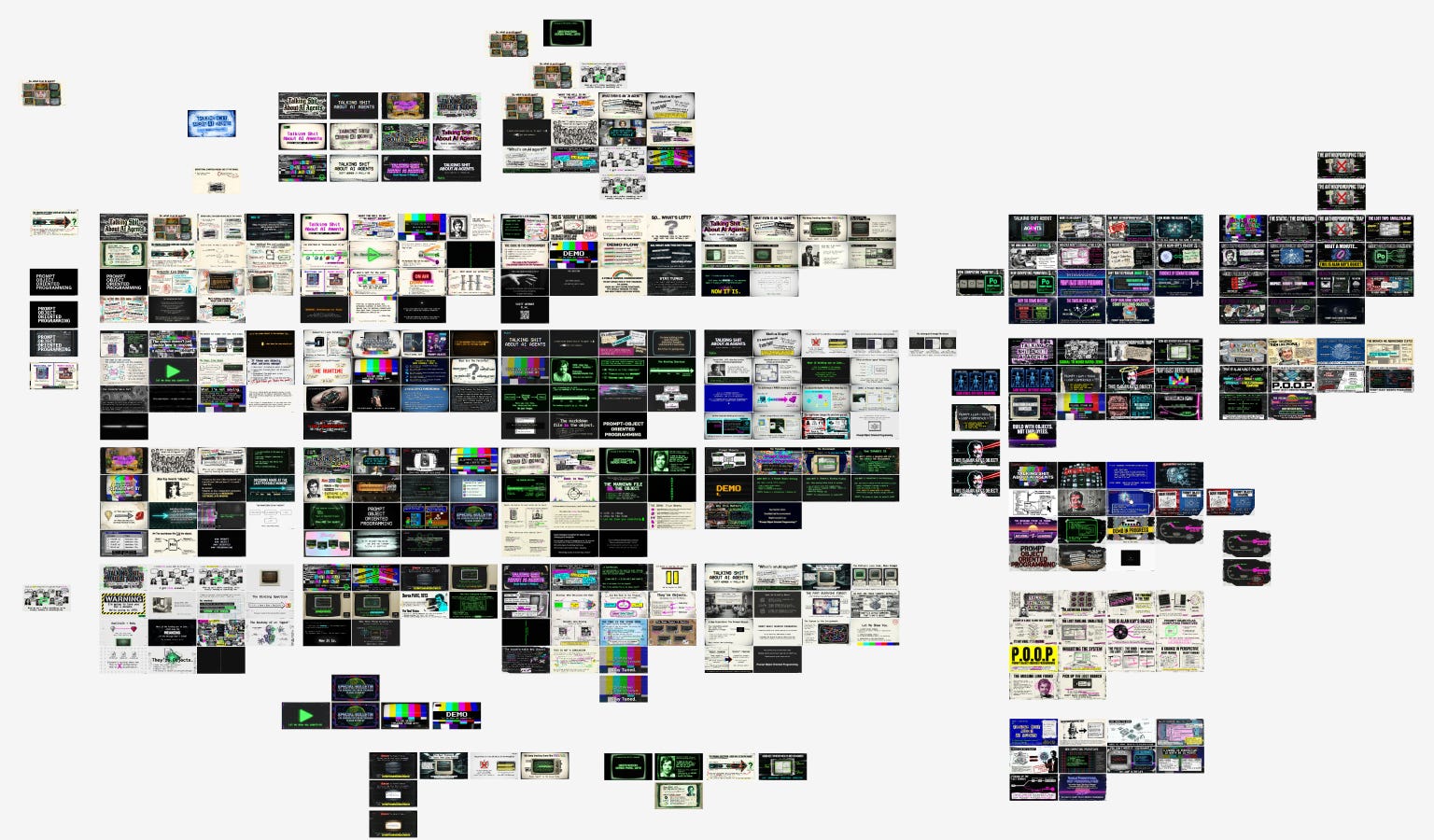
Then I picked my favorite slide from each batch. This one has the right energy. That one nails the layout. Oh, this title slide from generation #14 is perfect. And I stitched the whole presentation together from the best parts of twenty different attempts.
After the talk, someone asked who designed my slides. So I briefly walked everyone through my process, and I heard someone in the back yell out: ”Your next talk should be about this process!”
It was that moment that made me realize I was going to have to build this thing for real.
Conjure
So I built the thing for real. It’s called Conjure and it’s up on GitHub now.
Here’s how it works:
First, you write your grimoire. That’s your style guide, your visual language, the mood, the rules of the world your slides live in. Every conjurer needs a grimoire.
Then, you paste in your outline. The one you’ve been curating with your LLM of choice. The one you and Claude or whoever have been going back and forth on, shaping the narrative, getting the structure right. The slides get extracted from it.
Then you press conjure.
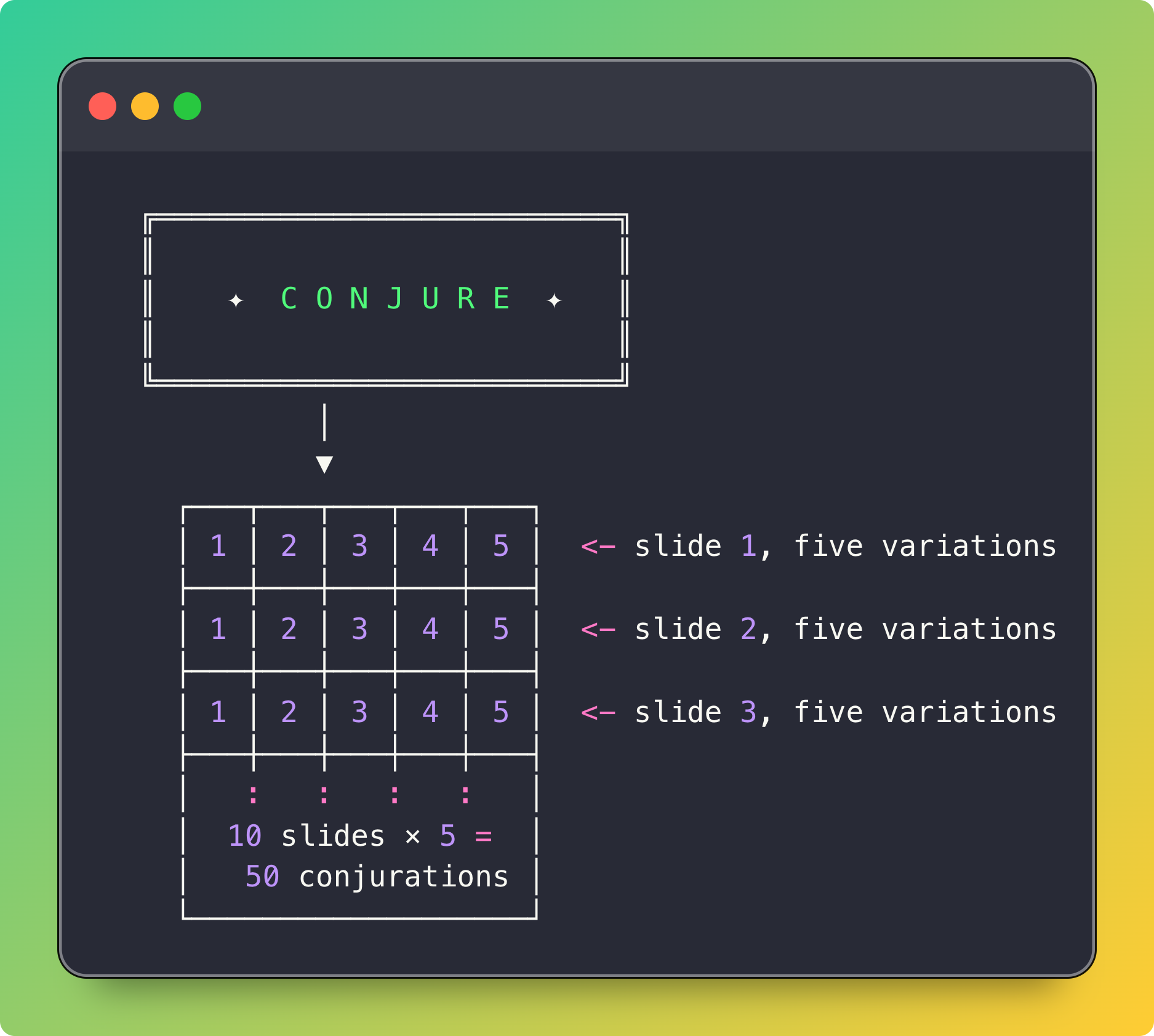
Five variations of each slide. Ten slides? Fifty images. You summon abundance. Then you curate, like the sports photographer. This one has a great background. The typography looks right on this one. I really like the layout from variation #5. You stitch. You refine. You do some light edits. You export to PDF or a zip of PNGs that you can throw into Figma to refine further.
It’s more work than prompting once and copying the output.
It might actually be more work than designing slides from scratch if you know what you’re doing.
But it’s a different kind of work. The kind where you’re choosing instead of constructing. Selecting instead of sculpting. And the choosing, the taste, that’s where you are.
Where the Scarcity Moved
The illusionists aren’t going anywhere. There are still photographers who shoot deliberately on film. There are still musicians who record live to tape. There are still people who will design every slide by hand. I’m sure there are a few software developers out there still using an IDE.
But remember what happened when film went digital. People mourned the death of photography. They were sure that when anyone could take a thousand photos, photos would stop meaning anything. That abundance would kill the art.
Instead, the art moved from capturing images to choosing them. From the shutter finger to the editing eye. From “can I get the shot?” to “can I find the shot, in all of this, and do I know it when I see it?” The technical act got cheap. The judgment got more valuable. And an entire universe of new things that nobody predicted, things that couldn’t have existed in the era of 36 exposures, grew in the space that opened up.
I think that’s what’s happening now. With slides, with code, with writing, with design, with whatever domain you’re generating abundance in. The raw material is becoming infinite. The craft is migrating somewhere else.
To the choosing. To the curating. To the willingness to generate forty-seven versions of something and throw them all away because the forty-eighth is the one that finally has the thing you couldn’t describe but recognized the instant you saw it.
The illusionist’s skill was precision. Getting it right in the moment because you only had one shot.
The conjurer’s skill is recognition. Summoning enough that the right thing can emerge, and then knowing it when it does.
That’s where craft lives now.
Conjure is up on GitHub. Bring your own API key. Fork it, clone it, bin/setup, bin/dev. If you make something cool with it, come show me.
The ecosystem part is what stays with me. Not the scarcity-to-abundance shift — that's well-mapped. But Flickr, Instagram, Lightroom weren't better cameras. They were new ways of living with an abundant medium. Organizing it, filtering it, finding patterns in it over time.
That's what's still mostly missing with AI. We're getting good at the conjuring. Your grimoire is one of the more interesting moves I've seen because it persists — it's not just choosing well once, it's encoding what "good" means so the next round starts from a higher floor. Most people's AI workflow resets every session.
Curious whether the grimoire evolves. Whether curating twenty batches changes what you put in the style guide for the twenty-first.