


You had a technique.
Don’t pretend you didn’t. Everyone had a technique.

Three short breaths, then one long one. Or two long breaths across the whole cartridge on either side. Or you put it in your shirt and blew through it like I did. You knew yours was the right one because it worked, and you could prove it, because the game started right up every time.
Want to know what was actually happening? The 72-pin connector inside the NES was just flaky. When you pulled the cartridge out and put it back in, the pins shifted enough to find a new grip. That’s it. That was the whole fix. Reseat the cartridge.
The blowing… the blowing was depositing moisture onto the contacts. Which corroded them. Which made the problem worse over time. Your technique was actively making things worse in a way that felt like magic.
The game still worked, but the blowing didn’t matter. Because the reseating was bundled inside the ritual. You couldn’t blow without removing the cartridge first. The fix was hiding inside the myth.
Everybody I know had a different technique. Every technique contained the same accidental mechanism. Everyone had proof.
You Are Doing This Right Now
You talk to machines. Probably every day. Maybe more hours a day than you talk to people, if you’re being honest about it. (… and yeah… same... )
And you have a technique. You might not call it a technique. You might call it “my process” or “how I prompt” or “the way that works for me”. But it’s a technique.
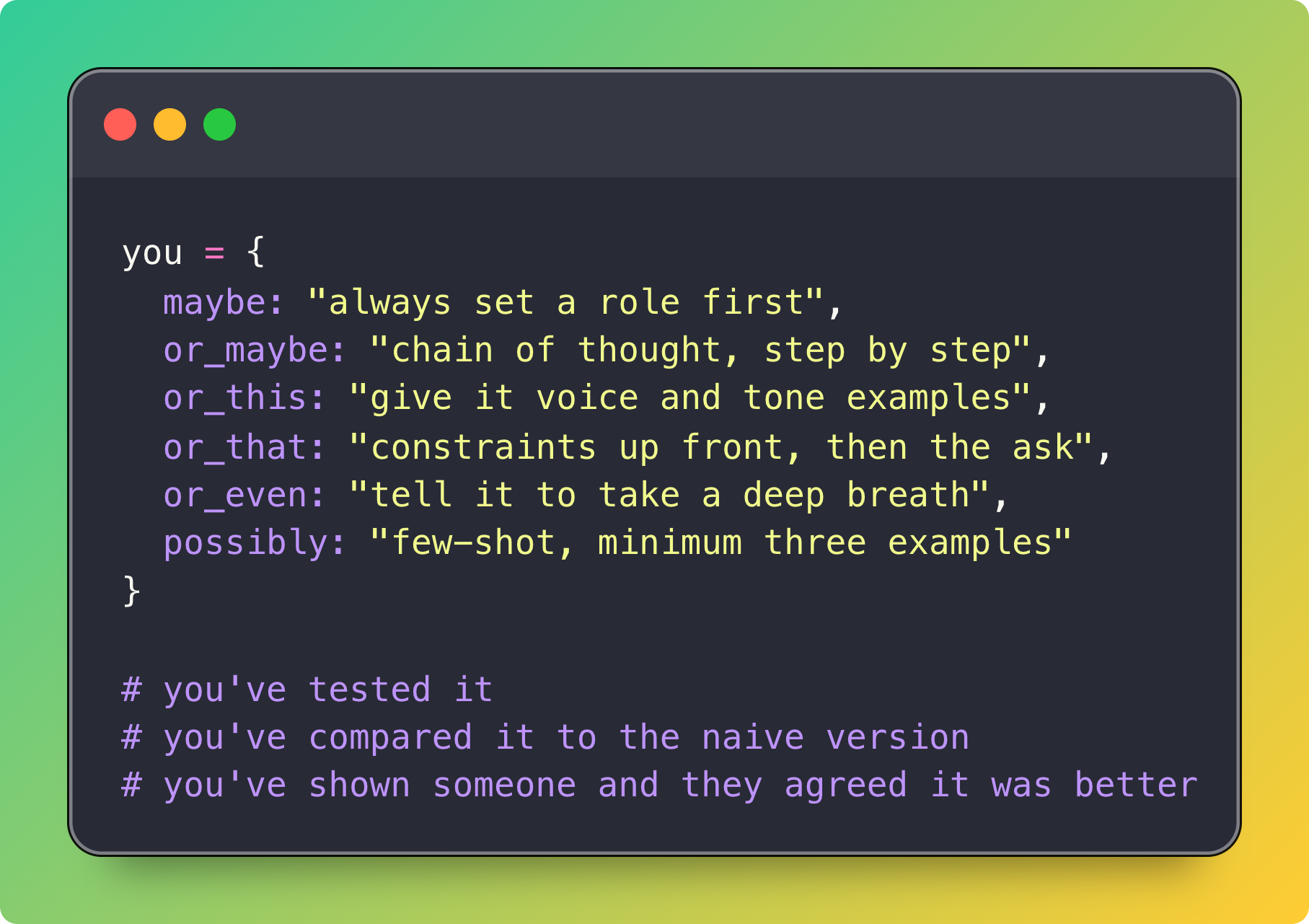
You probably already suspect this, deep down, but do you want to know the myth that technique is hiding?
Any structured prompting beats naive prompting.
That’s the pin reseat. That’s the whole mechanism hiding inside every framework and every acronym and every “ultimate guide to prompt engineering” blog post with 47 clap emojis.
Go from typing “do this thing” to literally any system where you think before you type (roles, constraints, examples, XML tags, markdown headers, repeating your prompt a second time, whatever) and you get better output. Meaningfully better. Showably better. Screenshottably better.
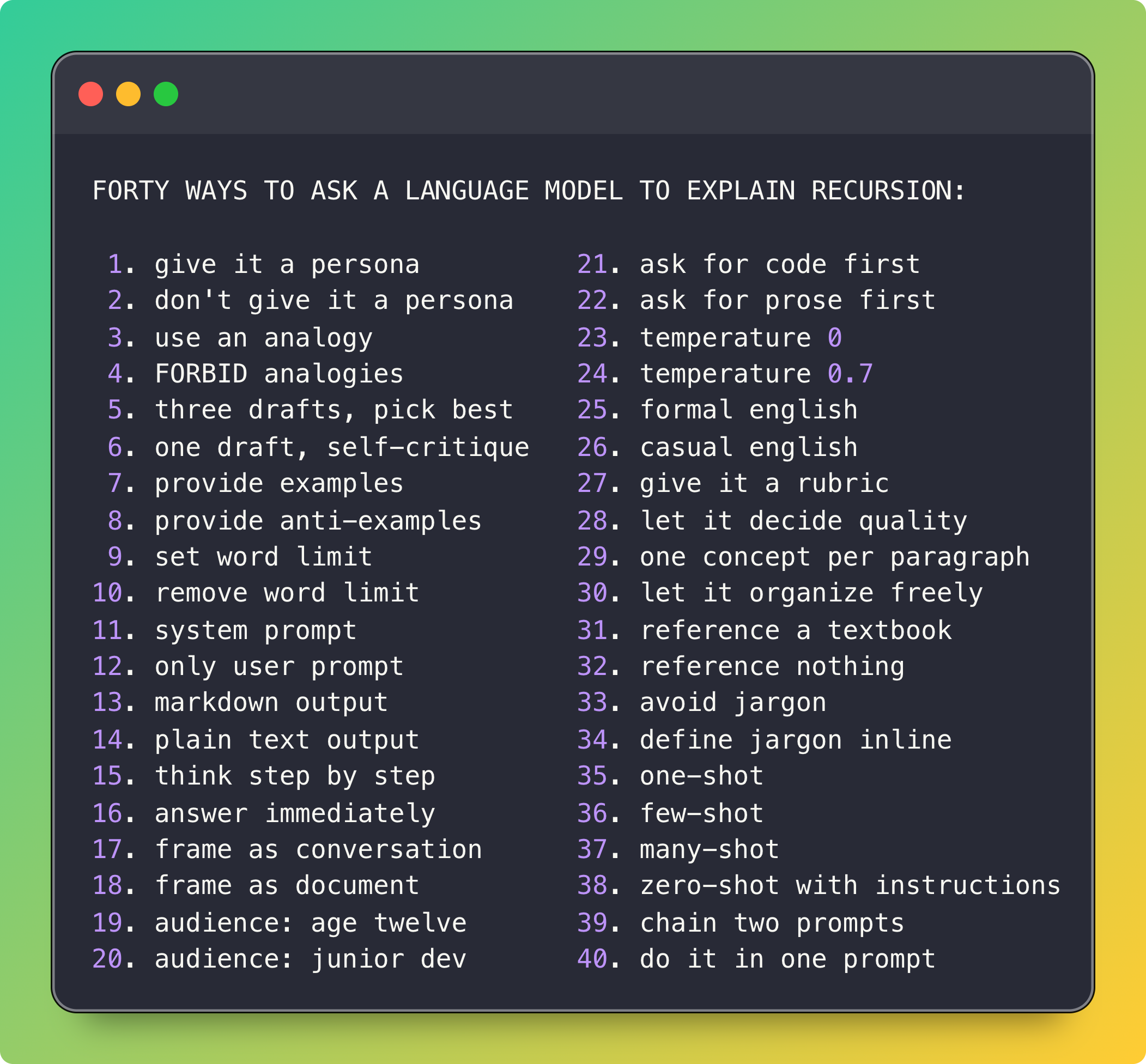
Everyone is right and nobody is special. I’m sorry. (I’m not sorry.) (Ok, I’m a little sorry, but not because of why you think… )
I’m sorry because I’ve set you up. It’s different from the NES example. It does actually work, but not for why you think.
A few months ago, we talked about how every possible arrangement of words that an LLM can produce already exists, the way every possible image exists in the space of all possible pixel arrangements, the way every book already exists in Borges’ Library of Babel, waiting on its shelf for someone to find it. The output you’re trying to reach is already sitting in the space of all possible token sequences. Your prompting technique is a lens that brings one arrangement into focus out of infinity.
But that’s only half the story. There are also an infinite number of lenses.
Pierre Menard, Author of Your Prompt
Borges has another story called “Pierre Menard, Author of the Quixote.” In it, Menard decides he wants to rewrite Don Quixote. But instead of just copying it or updating it for a modern audience, he wants to produce the exact same text, word for word, by arriving at it through his own life and his own reading and his own suffering and experience.
He’s able to accomplish the task for at least a few chapters.
It sounds like a silly premise, but the real message from Borges comes through when he puts the two versions side by side (Cervantes’ and Menard’s, which are identical, letter for letter) and argues that Menard’s version is richer. When Cervantes writes “truth, whose mother is history,” it’s a routine rhetorical flourish from a seventeenth-century Spaniard. When Menard writes the identical phrase, it’s a staggering philosophical claim, because Menard is a contemporary of William James and Bertrand Russell. He chose these words while knowing everything that came after Cervantes. The text is exactly the same, but the act of producing it was different.
The richness comes from the path the words took to make it to the page.
Connecting This Back To What We’ve Been Talking About
Every time you sit down at a chat window and write a prompt, you are authoring an output. The LLM generates it, sure. But you arrived at that specific generation through your specific process, your specific thinking, your specific way of structuring a question. The prompt carries the full weight of how you got there. And that means the output does too.
This is the Menard situation. The process of arriving is itself a creative act. You shaped the question, which shaped the output, which means the output carries the imprint of your path through it. When you evaluate that output, you’re evaluating something you authored, through your own weird journey, the same way Menard authored the Quixote through his.
And the person who copies your prompt template and gets the exact same text? They produced a different artifact. Same words. Different authorship. Different relationship to what those words mean and whether they’re right. They didn’t take the path; they photocopied the destination. It’s Cervantes’ Quixote to them. Fine. Good. Historically significant. But it didn’t come from where they’ve been.
This is why techniques don’t transfer well. Why there are so many different ones. It looks like the technique is the thing, the way the blowing looked like the thing. But the technique is just the visible residue of a whole cognitive path, and the path is what actually does the work.
There’s no manual for talking to machines. Or there are ten thousand manuals, which is the same thing. Everyone’s blowing on the cartridge. Everyone’s got proof. The mechanism is trivial and identical across all of them, and also completely irrelevant, because the thing that actually matters is the weird, unrepeatable path you took to get there.
Your prompting technique isn’t special because of what it does to the model. It’s special because of what it does to you.
Don’t Believe Me? Go Find Out!
So Claude and I built a little artifact game to explore this. (I know, I know. "Scott built a thing with Claude" is basically the subtitle of this newsletter at this point… )
It’s here. Eight challenges. Each one gives you a target output and says: get there. However you want. Whatever technique you’ve got. Blow on the cartridge your way.
It’s also got a gallery to explore the different ways other people got there. Every prompt that hits above 60% accuracy to the target text gets added.
Some will be long. Some will be absurdly short. Some using roles, some read like bullet points, and some that just say “output this exact text: [text]”. They are all correct. They are all different. They arrive at the same place from entirely different directions.
But, don’t just look at the gallery. Play it. Watch yourself prompt. Watch what you reach for when nobody’s giving you a framework. The shape of your instinct is the interesting part here.
Go be Menard. Go produce the Quixote your way. Then look at the gallery and see all the other Menards.
You have a technique. Now you know who it’s for.
I did have a NES so that part lands... but I will _never_ speak to the machine.