


Note: I just enabled paid subscriptions for $8/month. Most of these essays will still be free, but I’m working on adding premium features to Artifact Land and launching a hosted version of Conjure among other upcoming products that will come with the subscription. I’m planning on increasing the price as the bundle grows. So upgrade your subscription now to lock in the intro price.
Ok… picture this… you’re standing at a self-checkout at a grocery store.
The screen is yelling at you about an unexpected item in the bagging area. You look down, is the unexpected item the banana? Is it your reusable totes? The machine doesn’t seem to want to give you any hints either way.
Behind you, a child is negotiating, in the loudest possible terms, for one of the pouches in their parent’s cart. A barcode is failing to scan for the eleventh time. And there’s one employee overseeing six of these machines like a shepherd whose sheep have all started doing their own taxes.
How did we get here?
Automated Salesforce Machine
In April 2026, Salesforce announced Headless 360.
The pitch, from Marc Benioff: “No browser required. The API is the UI.”
You can basically translate this to:
we’re no longer going to ship you software. we’re going to ship you the raw materials of software. you can figure out the rest.
If you heard this and shrugged, I don’t blame you. It’s an API. APIs are old. What’s the big deal?
The big deal is that Salesforce is the largest enterprise software vendor on earth, and they just told their entire customer base that the part of the product they use most is no longer Salesforce’s job.
It is the customer’s job.
I don’t think Salesforce is going to be the only time we see this. I see this as a direction of travel announcement. Every major enterprise vendor is going to do some version of this in the next eighteen months. They’re going to call it different things or dress it up in different words. But the shape will be the same: the vendor ships the substrate, and somebody at your company assembles the substrate into something that does work.
That somebody is probably going to be you.
Unbundling Implementation
Now I know that “the vendor used to do this for you” isn’t the whole story.
Implementation labor was always layered across an ecosystem with a thin slice of vendor-paid solutions engineers at the top, a much bigger slice of customer-paid integrators and agencies in the middle, and underneath all of it, a job category. The Salesforce admin. The Design Ops or Marketing Ops Manager. People whose entire role inside your company was to configure another company’s products for you.
The customer was always expected to pay for most of the cake.
Headless 360 just significantly changes the scope of what the people the customer was already paying are now expected to do.
The Salesforce admin role gets re-scoped. What used to be “click through the configuration screens that Salesforce designed for you.” Now has no screens and the admin is wiring together workflows that didn’t exist as a product feature an hour ago using agents, MCP, custom integrations, things that don’t have a Trailhead course yet. And that’s just the people who already had the role.
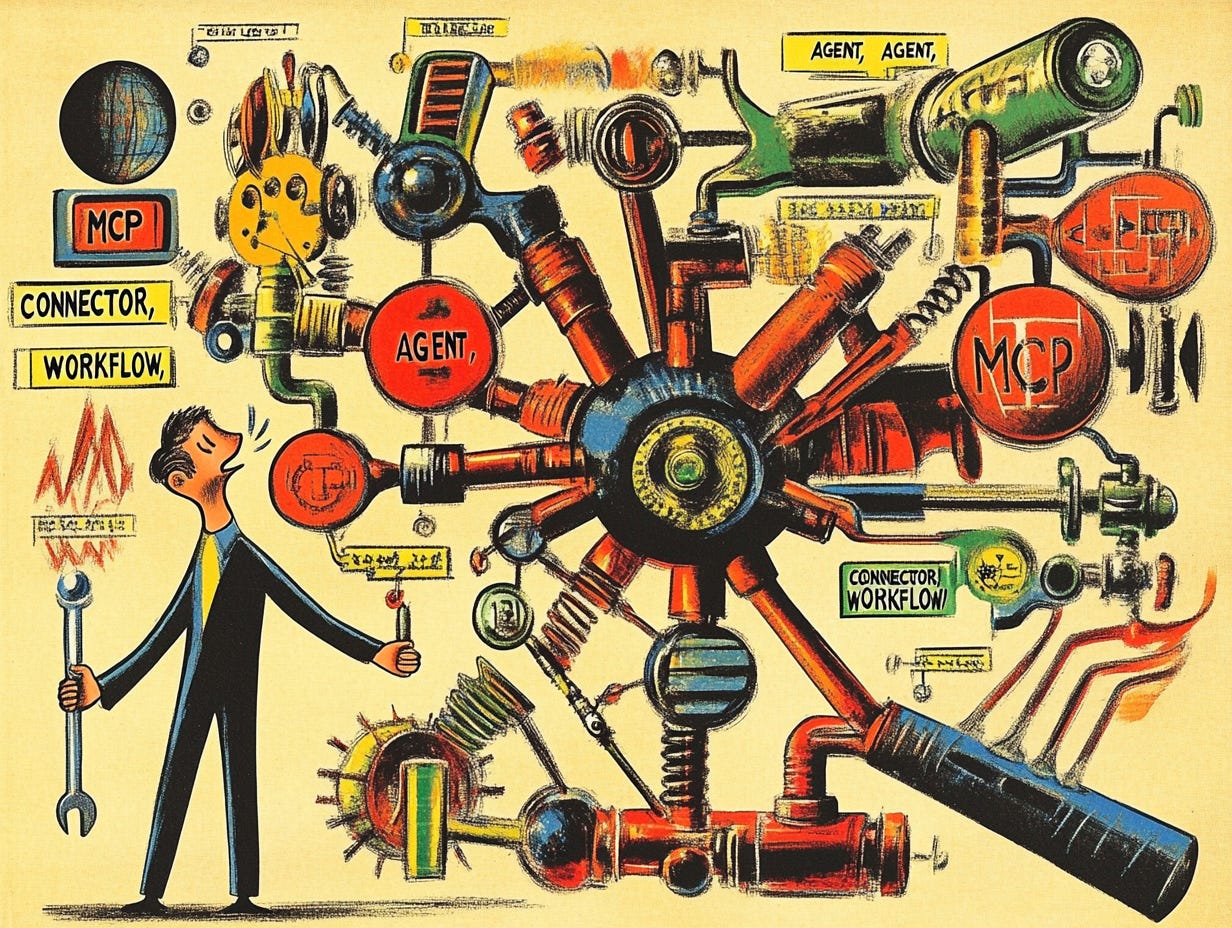
But to me what this hints at is that every other function in your company is about to need its own version of that role. Marketing needs one. Finance needs one. Legal, ops, support, recruiting, even engineering. Each function uses different software and lives in a different corner of the business, but each one now needs somebody whose job is to translate generic AI capability into something that does work here, specifically.
It was easy to name this person’s role when they only existed inside one product. But what do you name the version of them about to exist in every department of every company at once?
I don’t know, but I think it means there’s about to be a lot of those people.
Enter Colonel Saunders
In 1917, in Memphis, a man named Clarence Saunders opened a store called Piggly Wiggly. (We used to live in much more whimsical times…)
Clarence had the wild idea to let you, the customer, walk around and pick your own groceries off the shelves.
Before Piggly Wiggly, you had to give a list to a clerk who fetched the things for you. That was the clerk’s entire job. They had everything memorized. They knew where the flour was, intimately, like family.
Saunders looked at that beautiful, dignified, fairly-paid clerk and said: “what if the customer just did that part, for free?”
And we said: “ok!”
We’ve been saying ok for over a hundred years.
1917 — customer picks items off the shelf (clerk loses one job)
1970s — barcodes price and inventory the items (clerk loses another)
2000s — customer scans the items themselves (clerk mostly stops existing)
Each wave needed a capability unlock. Open-shelf store layouts. UPC codes. Cheap touchscreens that could yell about bagging areas without needing a human supervisor for every single machine.
And each wave was sold as convenience.
Yes, I understand that the clerk job mostly disappeared, but the point is that the labor didn't. The consumer now has to do it. For enterprise software it's a bit different, you're not choosing to enter the Salesforce store, that decision is made for you.
Here comes everybody (again)
Fast forward to 2008. A guy named Clay Shirky wrote a book called Here Comes Everybody.
The book’s argument was essentially that institutions exist because coordinating people is expensive. You need bosses, processes, headquarters, payroll, and a building with the company name on it because otherwise nothing gets done. The firm exists to absorb coordination costs.
Shirky’s bet was that the internet collapsed those costs to near zero which caused institutional functions to start leaking out into ad-hoc groups. Wikipedia over Britannica. Flash mobs happened. Coordination got cheap enough to organize without organizations.
Eighteen years later, almost exactly, I think we are watching the same trick get pulled with a different cost curve.
That was the coordination story. We are now living through the building story.
Building complex software used to require a software company. You needed engineers, and a build process, and a UI design phase, and someone whose entire job was figuring out what to do with the JIRA tickets. Building was institutionally expensive in the same way coordinating used to be.
Agentic coding tools, MCP, headless platforms, and so on are already starting to do to building what the internet did to coordinating. Building is cheap now and people everywhere are waking up to it. A finance lead can spin up a reconciliation agent on a Tuesday afternoon. A recruiter can wire up a candidate-research workflow over coffee and a chocolate croissant.
Coordination got cheap enough to organize without organizations.
Implementation got cheap enough to implement without implementers.
Shirky’s everybody came together. Ours comes apart.

His version produced Wikipedia where a million people work together to build one thing. The 2026 version produces a million people each building their own separate thing in their own separate corner of their own separate company. A million reconciliation agents. A million candidate-research workflows. None of them shareable. None of them composable. The disintermediation is the same; the sociology is the opposite.
The old everybody convened. The new everybody atomizes. Coordination was a tax we paid because software was scarce, and we don’t have to pay it anymore. This is what software finally being abundant looks like.
Pit Crew
So what do we call this person? The one in marketing or finance or legal who’s now expected to translate generic AI capability into something that does work in their corner of the business?
I’ve been using Pit Crew over in Near Zero, but I’m sure we’ll call it something else. Though I’m not convinced we’ll use Stripe’s Forward Deployed AI Accelerator, Marketing either.
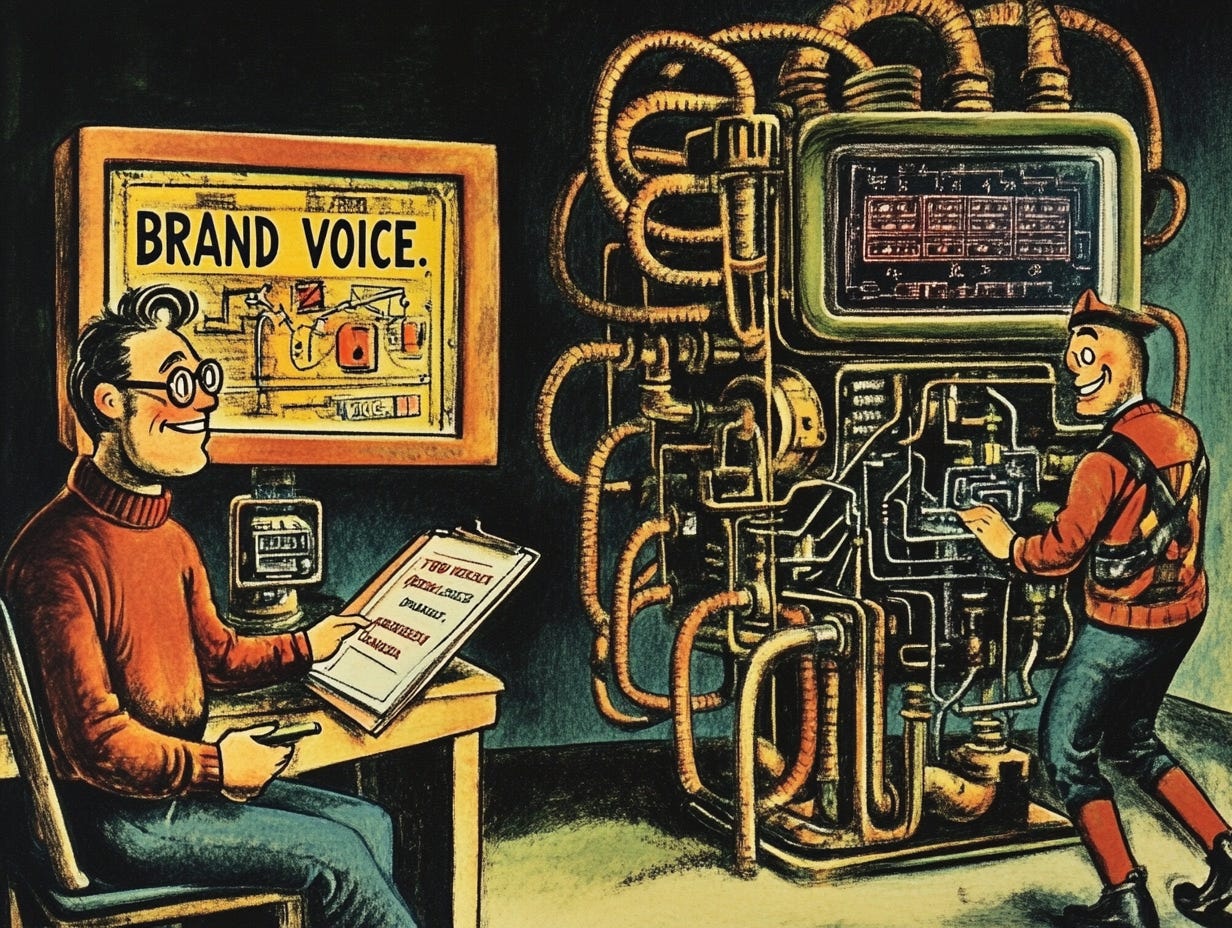
Your marketer has the taste. They know your brand voice, what’s been tried, when a subject line is going to land and when it wont. The marketer is the driver. The car they’re now driving is AI. It is powerful, fast, finicky, capable of going off the track in genuinely surprising ways if it isn’t tuned correctly. The Pit Crew tunes the car.
You can’t expect every marketer to know how to configure an MCP server or stitch six APIs together with an agent. Similarly the Pit Crew doesn’t need to write a brand voice guide. Neither of them wins the race alone. The marketer brings what to build and why. The Pit Crew brings how to build it and how to keep it running at speed.
Every domain expert in your company is about to need their Pit Crew counterpart. Or be one. Or both.
There are two reasons every function is going to need this person, and they push in the same direction.
The first is what we’ve been talking about all post. Headless platforms externalize implementation labor onto your team. You’re forward-deployed for the vendor just billed to your own employer.
The second is bigger and more permanent than any one vendor. Models are generic. The model doesn’t know your customers, your data, your weird Q3 reporting requirement, the fact that one specific salesperson refuses to use the new CRM no matter how many times you ask. AI capability only becomes useful at the point of contact with a specific workflow, dataset, or person. It doesn’t make sense to have a central “AI team” any more than it would be to have a central “Excel team.” Every function gets its own.
I personally like “Pit Crew.” But I’m sure the industry is going to come up with something else (maybe better? I don’t know…). But the role is real before its vocabulary is, and I’d rather pick an imperfect name than wait around for a good one.
Empowerment and Extraction
I do truly believe this is empowerment. Pit Crew is a real career path with real leverage, and the people who get good at it early are going to eat extremely well. People can genuinely do things they couldn’t do a year ago, and I’m blown away by the things I’ve been seeing.
Which is different from what you see in most headlines these days. The current consensus is that all of this means the need for fewer jobs. One Pit Crew member, they say, can do the work that used to take twenty marketers. So you keep the Pit Crew, you lay off the twenty, and you write yourself a thank-you note in the form of an EBITDA improvement.
I think this is wrong about the direction of the change.
The marketing team doesn’t shrink. It grows. So does the Pit Crew supporting it. Both numbers go up. Once a marketer paired with a Pit Crew is dramatically more productive, that pair is dramatically more valuable to the business. Valuable functions don’t shrink. They get more budget. They hire. The output expands, and demand expands with it, because there turn out to be enormous amounts of marketing work that nobody could previously imagine doing because nobody could previously afford to do it.
So you don’t go from 20 marketers to 1 marketer plus 1 Pit Crew. You go from 20 marketers to 25 marketers plus 5 Pit Crew. Then 30 plus 10. The Pit Crew ratio rises. The marketing team rises with it. The whole org chart gets taller. The labor multiplies. Every other time in history that software engineering became cheaper, demand skyrocketed. Why would this time be any different?
Call one bet “Substitution” if a company sees Pit Crew as a way to do the same work cheaper. The other “Multiplication” if a company sees Pit Crew as a way to do much more work, period.
Both are happening in different companies right now. Only one of them is right about the future. The companies betting on substitution are going to wonder, in about eighteen months, where their competitive advantage went. The answer will be that it went to the company that hired more people and more pit crew for them, not fewer.
The Pit Crew that bets on Multiplication is the one that builds something between races — not just skilled hands, but a running record of what the car needed last time, what broke, why. Without that layer, the next race starts from the driver's memory, not the system's.
The Multiplication outcome requires a different practice underneath the role, not just more of the same labor.
Good thoughts... Leaves me wondering how many companies are going to pivot from headless platforms to in house dev with these moves... Also what these shifts will mean for the still large share of orgs stuck on legacy systems like public sector cobol code or enterprise lock in...