


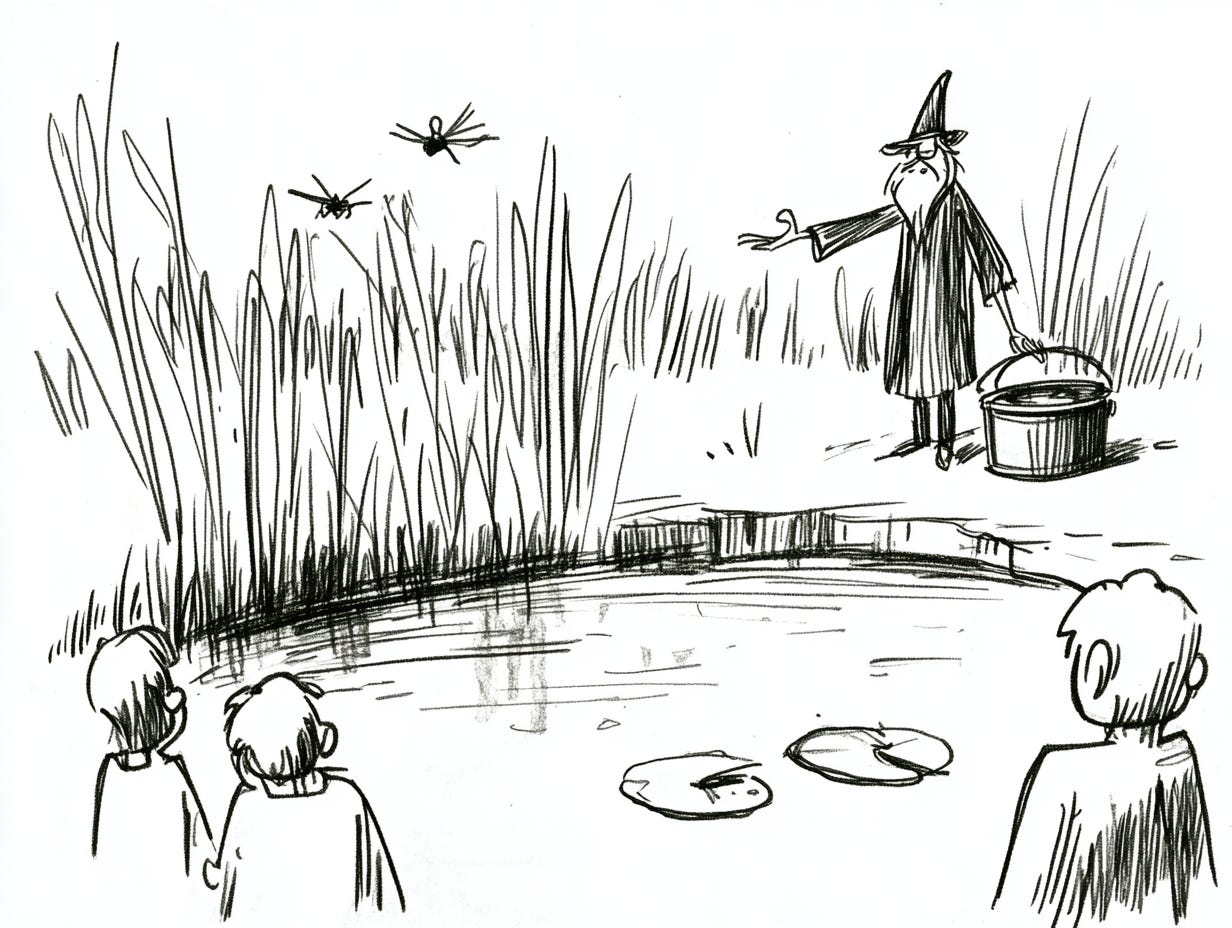
There was once a wizard who lived beside a pond. It was a small pond. The sort of pond that probably gets called a “water feature” on a Zillow listing by a real estate agent who really knows their euphemisms.
The wizard loved it.
“This,” he said, “is my moat.”
The villagers looked at the pond. A frog blinked.
“It is a pond,” said the baker.
“It is proprietary,” said the wizard.
The baker nodded, because he wasn’t exactly sure what that meant and had learned, over many years, that asking wizards follow-up questions was how you lost an afternoon.
The pond contained reeds, stones, three dragonflies, and a bucket the wizard had dropped in there in April and decided not to retrieve for strategic reasons. Most importantly, the pond contained data.
Every morning, the wizard measured the pond. He measured the ripples. He measured the frogs. He measured frog sentiment, which was mostly negative but trending toward neutral after a successful lily pad migration. He wrote everything down in a leather-bound notebook labeled:
UNIQUE PROPRIETARY POND INTELLIGENCE
SERIES A
“No one else has this data,” he told his apprentice.
The apprentice looked at the pond. “Does anyone else really want this data?”
The wizard frowned. “You lack vision.”
This was true. The apprentice lacked many things. Vision. Health insurance. A working understanding of cap tables. But she did have the irritating habit of asking questions the wizard didn’t quite feel like grappling with.
I. Pond
One day, a traveling sorcerer arrived. He carried no notebook, no wand, no leather-bound corpus of amphibian engagement metrics. Just a small black box.
The wizard disliked him immediately. This was partly because of the box, partly because of the hat, and partly because the sorcerer had the relaxed posture of someone who had never once maintained a production pond.
“What is the likely frog distribution in a pond of this size?” asked the sorcerer.
The box hummed. (Or maybe the sorcerer hummed. It was difficult to tell from where I sat.)
“Between six and twelve frogs,” said the box.
The wizard gasped. (The pond was home to nine frogs. I counted them this morning.)
“How did it know?”
“It has seen ponds,” said the sorcerer.
“But not my pond.”
“No. Just ponds.”
The wizard clutched his notebook. The frog blinked again.
“But my frog data is private,” said the wizard.
“Yes.”
“And unique.”
“All ponds are unique.”
“And therefore valuable.”
The sorcerer looked at the pond. Then at the notebook. Then at the apprentice, who had begun writing something down on a loose piece of parchment.
“What are you writing?” asked the wizard.
“Nothing.”
“Is it about the pond?”
“...”
“Is it about me?”
The apprentice did not look up. The quill kept moving.
The sorcerer walked to the edge of the pond. “One,” he said. The wizard stiffened. “Two.” The frog looked insulted. “Three. Four. Five.” The apprentice kept writing. “Six. Seven. Eight. Nine.”
The wizard became very still. Wizards almost never learn lessons at the first available opportunity. If they did, there would be far fewer towers and almost no enterprise software.
Still, something had happened. The pond’s surface, which had been pleasantly choppy, had gone briefly flat. The notebook, which had felt heavy in the wizard’s hand all morning, had stopped feeling like an asset.
II. Pond
The wizard recovered quickly. Wizards are resilient creatures.
“Frogs are simple,” he said. “But serious domains are different.”
The sorcerer sighed. The apprentice sat on a stone. She knew this tone. This was case-study tone.
“Consider,” said the wizard, “the Text-Predicting Goblins of Gloomburg.”
(The official name is Gloomburg Goblins Predicting Text. He always preferred to say it the other way around for some reason.)
The Goblins of Gloomburg, the wizard explained, were serious, premium goblins. Fed for years on hand-selected financial scrolls, market incantations, analyst marginalia, and several warehouses of documents written by people who say “bips” in everyday speech instead of “basis point”. They had a tower, a paper, a launch announcement, all sorts of diagrams with arrows.
“And they worked,” said the wizard. “The Goblins of Gloomburg answered finance questions better than any general goblin.”
“Yes,” said the sorcerer.
The wizard waited for the rest. The sorcerer did not provide the rest. He tapped the black box.
A goblin climbed out. Somewhat larger than the box should have permitted. It had the patient expression of something that had been asked everything and was unimpressed by most of it.
“Ask it about basis points,” said the sorcerer.
The wizard, against his better judgment, asked.
The general goblin answered. The answer was correct. The answer was fluent. The answer was, crucially, free. Then the goblin yawned and added an unsolicited but technically helpful comment about the swap curve.
A long quiet settled over the pond. Somewhere, in a tower that nobody had visited in months, the Goblins of Gloomburg were sitting alone in expensive robes.
“Oh,” said the wizard.
“Yes,” said the sorcerer.
The wizard objected. “Gloomburg had an advantage.”
“Yes.”
“In a serious domain.”
“Yes.”
“With real proprietary scrolls.”
“Yes.”
The wizard waited. The sorcerer did not continue. This was one of the sorcerer’s worst habits. He would let the silence finish the sentence, which saved time but made people want to push him into ponds.
“The frontier got bigger,” the sorcerer said eventually. “The frontier always gets bigger. That’s why it’s called a frontier.”
The apprentice wrote that down.
“Stop writing down the sorcerer,” said the wizard.
The parchment now contained the sentence: Stop writing down the sorcerer. This is the danger of apprentices. They are not proprietary in the way notebooks are proprietary. They have legs. And opinions. And, occasionally, better version control.
The wizard turned back to the sorcerer. “But the specialist goblin was better.”
“For a while.”
“That counts.”
“It does. It just doesn’t keep counting.”
III. Pond
The wizard tried again. “Usage data is one thing. Domain data is another. But we have outcome data.“
Usage data says: A frog sat on this lily pad. Outcome data says: A frog sat on this lily pad, caught three flies, renewed its annual contract, and referred two other frogs, one of whom had budget authority.
The wizard had plenty of it. He knew which frogs stayed and which frogs left. Which frogs caught flies and which frogs failed to catch flies but demonstrated strong intent. He had cohorts. Retention curves. A surprisingly mature pond analytics stack.
The sorcerer studied the notebook. “This is better.”
The wizard smiled. The apprentice, who had learned to fear this exact amount of praise, did not.
“Still mostly a notebook,” said the sorcerer.
“But outcomes are real.“
“Yes.”
“And private.”
“Sometimes.”
“And important.”
“Occasionally.”
The wizard waited for the therefore. It did not arrive. This is a thing therefore does when it knows it is about to be abused.
The sorcerer flipped through the pages. Some outcomes were old. Some described a pond that no longer existed. Some were caused by weather. Some were caused by a temporary shortage of flies. And some, like when frog retention had unexpectedly jumped forty percent, were caused by the apprentice quietly moving three stones last winter, which no one had logged.
The apprentice cleared her throat. “Your outcome data has three different spellings of ‘fly.’”
“That’s impossible.”
She turned the page of the notebook.
fly
flies
airborne protein interaction
The wizard looked away.
The pond, somewhere underneath the conversation, lost a frog. Nobody saw it leave. Eight frogs now, where there had been nine. The wizard’s analytics stack would not register the change until the morning measurement, by which time the frog would be a churn event, a number, a row, a story told without the frog in it.
IV. Pond
The wizard, sensing momentum slipping away, started in on a new argument. He had a long preamble queued up, with citations to several burger chains, about how data produces actions, how strategy emerges from analysis, how the truly defensible advantage was knowing what to do next.
The sorcerer cut him off. He pointed.
Across the road, where there had not been a pond before, there was a pond. A small sign beside it read:
KING BURGER’S ROYAL AMPHIBIAN POND
NOW WITH FLIES
“That was fast.”
“They watched where you built. Someone is always watching where you build.”
“Our research was proprietary.”
“Your research was. Your location wasn’t.”
Some data is private until you use it. Then it becomes a footprint. You spend years learning which customers matter, which workflows are valuable, which market segments are ready, which integrations unlock distribution, which pricing model works, which vertical is secretly desperate, which pond should be built near which road. Then you act. You ship the feature. You enter the vertical. And now everyone else gets to ask a much cheaper question: why did they do that?
The wizard hated this question.
Two frogs left the wizard’s pond and crossed the road. They did not announce themselves. Frogs are not dramatic creatures. They leave in small, wet increments. Six frogs now.
V. Notebook
Throughout this conversation the pond had become lighter. Not dramatically. Wizards notice dramatic things, and ponds, in general, are too dignified to make a scene. But the water level was perhaps an inch below the lip of the largest stone, and the largest stone had been the wizard’s reference point for years.
The sorcerer turned to the apprentice. “Do you understand the pond?”
“Yes.”
“The frogs?”
“Yes.”
“The outcomes?”
“The parts that matter.”
“The parts in the notebook?”
“Some.”
“The parts not in the notebook?”
The apprentice looked at the wizard. Then at the pond, which was now visibly less of a pond than it had been at breakfast.
“Yes.”
The sorcerer nodded. “I’m hiring.”
The wizard stood. “You can’t hire my apprentice.”
“Why not?”
“She knows proprietary things.”
The sorcerer considered this. Then he looked at the apprentice. “Are you proprietary?”
“No,” she said.
She said it gently. The wizard, who had spent a career being told things confidently by people who turned out to be wrong, had no defense against being told something gently by a person who turned out to be right.
“I assumed,” said the wizard.
The sorcerer waited.
“I assumed,” said the wizard again, “that what mattered about the pond was the pond.”
The sorcerer nodded once, slowly.
The apprentice picked up her parchment. She did not pick up the notebook, which was not hers and had never really been about her, although it had quietly become about her in places the wizard had not been measuring.
She left.
The pond was now noticeably lower. The wizard had not seen anyone take any water.
VI. Pond
The pond remained. The frogs remained, the ones still there anyway. The bucket remained, still strategic. The notebook remained under the wizard’s arm, still leather-bound, still labeled.
The wizard opened to a fresh page. At the top, he had written:
UNIQUE PROPRIETARY POND INTELLIGENCE
He stared at it for a long time.
Then he crossed out UNIQUE.
Then PROPRIETARY.
Then INTELLIGENCE.
This left:
POND
Which was accurate, but not especially fundable.
Across the road, King Burger’s pond had a line. The wizard watched another of his frogs climb out of the water and cross over.
From somewhere a small voice said:
“Between six and twelve.”
The wizard looked at the pond.
There were five frogs.
For now.
VII. Parchment
The wizard did what any rational pond-manager does when faced with a shrinking moat and a sudden absence of human overhead: he bought a goblin.
It was a very nice goblin. He leased it for a fraction of the cost of an apprentice’s health insurance. He stood it by the edge of the water, dusted off his hands, and prepared for efficiency.
“Optimize the frogs,” said the wizard.
The goblin blinked. “Please define ‘optimize’ in the context of amphibious asset management.”
The wizard opened his mouth. Then he closed it. He looked at his notebook. He had ten years of data on how many frogs there were, but he suddenly realized, with a very cold and very specific kind of horror, that he had never actually decided what a good number of frogs was. He knew how to measure the pond. He did not know how to run it.
He turned to ask the apprentice, but of course, the apprentice was currently halfway down the road to the sorcerer’s camp.
“Wait,” the wizard yelled after her. “He doesn’t need you! He has the black box! The box can do your job!”
The apprentice stopped. She looked at the sorcerer. It was a fair question. The box had already proved it could count, predict, and reason.
“Why are you hiring me?” she asked.
The sorcerer tapped the black box. “It knows the physics of water. The biology of frogs. The statistical likelihood of dragonflies.”
He paused, the way he paused.
“It does not know what we are trying to do with the pond. Goblins produce text. They do not produce judgment. I have a great many answers. I have very few people who know which questions are worth the asking.”
The apprentice nodded. This made sense. The frontier always gets bigger, but someone still has to decide which part of it to settle.
Across the road, the wizard was arguing with his new goblin about whether a bucket was a feature or a bug.
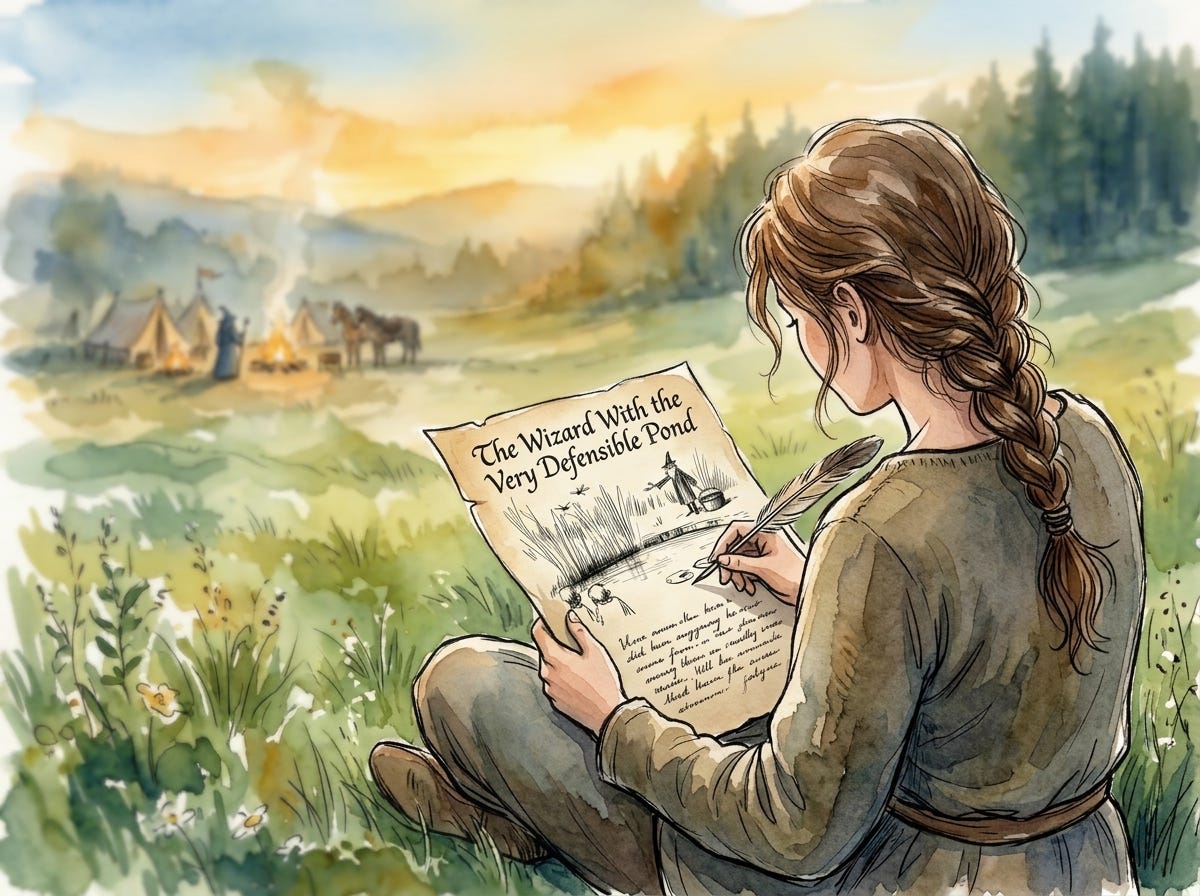
The apprentice found a comfortable spot on the grass, a safe distance from all of it, and smoothed out her loose piece of parchment. She still had a few things to write down before she officially started the new job.
The sorcerer glanced over her shoulder. “What is that?”
“Nothing.”
“Is it about the pond?”
“A little.”
Subscribe to Works on My Machine.
Free for the essays; $8/month for the full bundle (artifact.land Pro today, more soon). Substack preserves your rate, so subscribing early means you keep $8 even as the bundle grows.
The wizard had ten years of data on how many frogs there were. He had never decided what a good number of frogs was.
That's not in the notebook. That's the thing on the parchment — what the pond is for, which side to defend, what "optimize" means before you say it out loud to a goblin who will wait, patiently, at considerable expense, for an answer you haven't written down yet.
I keep mine in a file. Less elegant than loose parchment. The goblin is equally grateful.