


Jim Barksdale, not the guy from The Wire (that was Avon), the Netscape guy. Before your time maybe. Definitely before mine in any meaningful sense. He said once that basically there are only two ways to make money in business: bundling and unbundling.
That’s it. That’s the whole theory of business. Everything is either getting stitched together or pulled apart. Cable TV bundles channels. iTunes unbundles albums into songs and Spotify bundles them back up. Newsletters unbundle journalism into individuals. Round and round. The great zipper of capitalism, forever zipping and unzipping.

It’s been on my mind lately because I think I accidentally discovered an unbundling opportunity, and it might be a big opportunity for others of you out there also dealing with Claude Code Psychosis (or I guess maybe make it worse…).
But first I’ve got to tell you how it all started.
Sixty People and a Lot of Pizza
In May 2024, I noticed nobody was talking about building things with AI in Ruby.
This was weird. Ruby people (“strange people”) are usually talking or blogging about everything. That’s like one of the defining characteristics of Ruby people. They at least talked about Web 3. But the Ruby + AI conversation was just... empty.
So I figured I’d try to get some people together. A happy hour. Low stakes. We booked a space at a bar in New York, posted about it, hoped maybe 10 or 20 people would show up so we could commiserate about the state of things and drink beer.
But sixty people showed up.
Sixty.
I had not prepared for sixty.
I had prepared for “a handful of people making small talk near a plate of nachos.” And so through no deliberate action I was now the organizer. The guy whose name is on the thing. The one people email when they have questions like “When is the next one?”
That happy hour eventually turned into what is now Artificial Ruby. A monthly meetup and community in New York focused on the intersection of Ruby and AI. With talks from people all around the world. Almost two years in now. And it has given me a much better appreciation for the Programmers’ Credo.

Nobody warns you about what running a community event actually involves. Or maybe they do and you don’t listen, because it seems like it should be simple. Get a room. Tell people when. Show up.
But then you actually do it. And you discover that it involves managing RSVPs across platforms. Syncing your attendance list with your mailing list so the people who come to events also get your emails and the people who read your emails know about events. Writing social media posts promoting the event. Writing social media posts after the event. Keeping track of who comes regularly and who signed up once and vanished. Estimating attendance so you know how much food to order, which is its own special art form because the conversion rate from “RSVP yes” to “actually shows up” fluctuates based on weather, day of week, season, vibes, proximity to holidays, and probably the phase of the moon.
And then there’s the feeling.
You know the feeling. It’s 6:10 PM. Doors opened at 6:00. Five people have arrived. You have fifteen pizzas. You are standing in a room that can hold eighty people and it is echoing. You check your phone. You check the RSVP list. Forty-seven people said yes. Five are here.
Where is everyone?

(They’re on the subway. Or at least that’s what the two who texted you said. Everyone will arrive in a wave at 6:25 and suddenly you won’t have enough pizza. This is the way.)
The CSV Purgatory
So the obvious first move would be to set up a Zapier integration, right? Luma handles RSVPs. Mailchimp handles the newsletter. Zap connects them. Solved.
But I looked at Zapier, and I looked at my problem, and I just felt exhausted. That kind of exhausted where learning a new tool to automate a tedious task feels more tedious than just... doing the tedious task. You know the feeling. You do the math in your head: time to learn Zapier, time to configure it, time to debug it when it inevitably does something wrong, versus just exporting a CSV from Luma and importing it into Mailchimp.
So of course I kept doing the CSV thing and the pain kept accumulating. The attendance guessing. The “did this person actually show up or just RSVP” mystery. The social media posts I’d write at 11 PM the night before because I forgot again. Every month, the same friction, in the same places, getting slightly more annoying each time.
And so at some point I started building something. Just for me. Just locally. A little app running on localhost that talked to the Luma API and the Mailchimp API and did the sync automatically and, while it was at it, started tracking some things the CSV shuffle never could. Who opens the newsletter. Who actually shows up versus who just RSVPs.
I used it like that for months. Just me, on my laptop, localhost:3000, red circle favicon, solving my own problem.
A Brief Digression…
Last weekend Claude and I built this interactive artifact called the Traffic Jam Explorer. The premise: when shipping containers dropped costs from $5.86 per ton to $0.16 per ton, it made entirely new categories of economic activity possible. IKEA is inconceivable without containers. Global supply chains are inconceivable without containers. The whole shape of the economy changed because one input got radically cheaper.
AI is doing this to software.
The Explorer maps the chain reactions. You start from “software costs approach zero” and branch outward through consequences, and you can use AI within the artifact itself to generate new branches from any node, extending the analysis wherever your curiosity takes you.
So I’m clicking through branches. And under “Previously unthinkable businesses become possible,” Claude generates this:
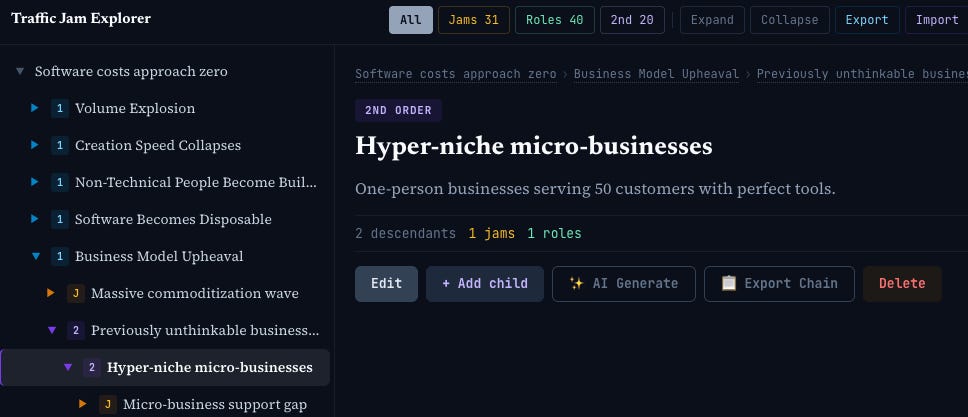
One-person businesses serving 50 customers with perfect tools.
I’d been saying something like this for like two years, in different words, with different framing. That the falling cost of building software was going to make it economical to build very specific tools for very narrow markets. That the gap between “not enough customers to justify building it” and “enough customers to justify building it” was collapsing. I’d been talking about it in the newsletter, thinking about it in the shower, explaining it badly to investors.
But I hadn’t quite said it this cleanly. Definitely not in interactive tree form. And here was Claude, arriving at the same place independently, just following the logic of what happens when a fundamental input gets cheap.
And I was sitting there looking at my laptop, where a little app on localhost was doing exactly this. A hyper-niche tool. For community organizers. Running Luma and Mailchimp. A market that definitely exists but is definitely not the kind of TAM that you’re ever going to put in a pitch deck.
I was inside my own prediction.
Where Is Everyone
So the localhost app has a name now, and it’s a real thing.
It’s called Where Is Everyone, named after the feeling. The 6:10 PM feeling. The echo and the pizzas.
It started as “do the CSV sync for me.” But a CSV doesn’t know anything. It doesn’t know that someone has opened every newsletter for six months but never come to an event. It doesn’t know that someone else RSVPs yes to everything and shows up to nothing. It doesn’t know that your last three events had a 62% show rate except when it rained, when it dropped to 41%.
So now it does more than sync. It watches who shows up, who doesn’t, who’s engaged, who’s drifting. It takes a guess at how many people will actually walk through the door. It’s not a crystal ball. But “this person has shown up to 8 of the last 10” is a very different signal than “this person has shown up to 0 of the last 10,” and if you know the difference, you order the right number of pizzas.
Forty bucks a month. One of those hyper-niche micro-businesses serving a small number of customers with a perfect tool. Or at least, that’s the plan. I’ll let you know how the 50-customer thing goes.
The Unbundling
So here’s where Barksdale comes back.
Zapier is a bundle. It’s the universal connector. Anything to anything. Which is powerful and also, for specific use cases, weirdly insufficient. Because “anything to anything” means nothing knows about your specific thing. A Zap is a pipe. Data goes in one end and comes out the other. It doesn’t understand that an RSVP has a probability attached to it. It doesn’t understand that the relationship between your events and your newsletter is the thing that makes your community cohere.
What Where Is Everyone does is pull one thread out of the Zapier bundle and build something that actually understands the domain.
This is unbundling. And it’s only possible because the economics changed.
A couple years ago, building a product this specific for a market this narrow would have been irrational. The development cost wouldn’t justify the revenue from a few hundred community organizers. So nobody built it. Everyone just did the CSV dance, or wrestled with Zapier, or just guessed.
But the cost of building software is falling the same way the cost of shipping fell. And when a fundamental input gets cheap enough, you get entirely new categories of activity. You get IKEA. You get global supply chains. You get a meetup organizer on his laptop building the tool he needs because now he actually can.
Meanwhile, the Fuckening
My friend Justin Searls wrote a piece this week called Brace for the Fuckening. His argument, roughly (if I’m getting it right?) is that a lot of white-collar workers are going to have a very bad time because of AI. The accountants, the junior lawyers, the management consultants, the engineers not learning the only skill that matters now. The possibility is real and the people in charge are not being honest about it.
But, I don’t know, I keep coming back to things I’m discovering in the Traffic Jam Explorer. Like that node, the one-person businesses serving 50 customers with perfect tools. And I look at what I’m doing right now. Running a community for people who are figuring out what comes next. Building a hyper-niche tool that wouldn’t have existed two years ago. Writing a newsletter about the intersection of code and creativity for people navigating the same uncertainty I am.
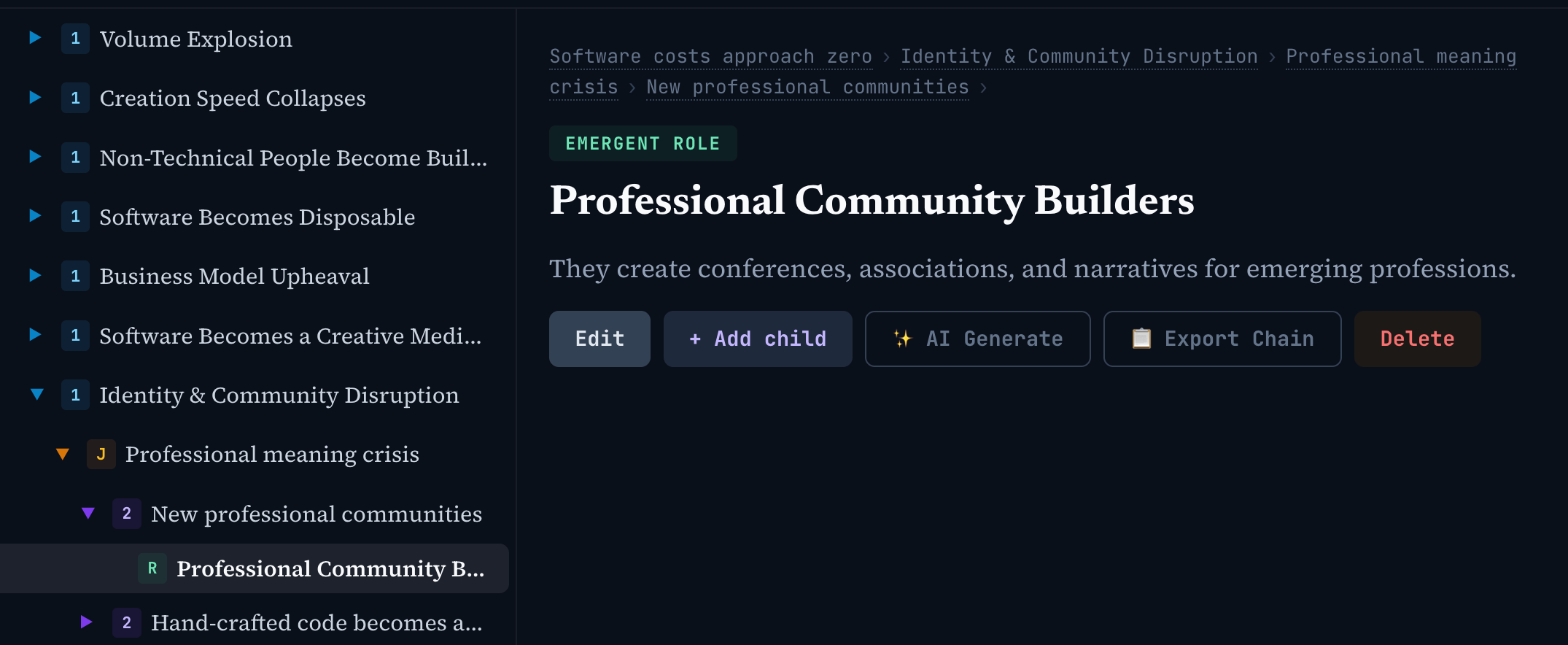
These are all new jobs. Or at least the initial rough sketches of a few different shapes that work can take. And I think there are going to be a lot more of them. Because when a fundamental input gets cheap, the variety of what becomes possible tends to explode in ways nobody predicts. Nobody predicted IKEA from cheaper shipping. Nobody predicted podcasting from cheaper bandwidth.
I don’t have the whole answer to Justin’s worry. But I am working on something that could be one. Inspired by what Protocolized has been doing the last year, I’ve been working with Claude to write short science fiction stories about what life might look like for the people doing jobs that don’t exist yet. What happens when the cost of software falls to near zero and what do the weird, specific, human-shaped niches start filling up with? More on that soon. Stay tuned.
In the meantime, what I’m really trying to say is, there’s an AI and Ruby community that meets monthly in New York, an app that can tell me how many of them will actually show up, and a tool you can use to explore what some jobs might look like in the future.
This feels a lot like convergence in an article about divergence when I consider the recent writings of https://www.substack.com/@limitededitionjonathan and https://www.substack.com/@russmiles
All in all, very interesting and a very apt example!
Is the cost really approaching zero though? It still needs a skilled dev to supervise. And any speed is offset by the cost of tokens. Cheaper yes. But approaching zero? Not sure.